
Protector Incident Research: Koroyd vs Airbag
Updates on back-protector research, including detailed accident reports involving Koroyd and airbag injuries.

This year, I’m continuing my research into harnesses.
First, some quick updates:
I made a video about the CIVL Harness Working Group’s progress and results - or lack thereof. It is linked at the end of this article.
I also did an interview with Paragliding Atlas about back protectors, which is also linked at the end.
All links are collected here: harness.hyperknot.com
Interactive Calculator
Based on Fred’s corrections to my article last year, I fixed my calculations and made an interactive harness back protector calculator here: https://harnessvis.hyperknot.com/
You can use it to calculate the minimum theoretical back protector thickness required to pass a given G-limit and jerk-limit requirement.
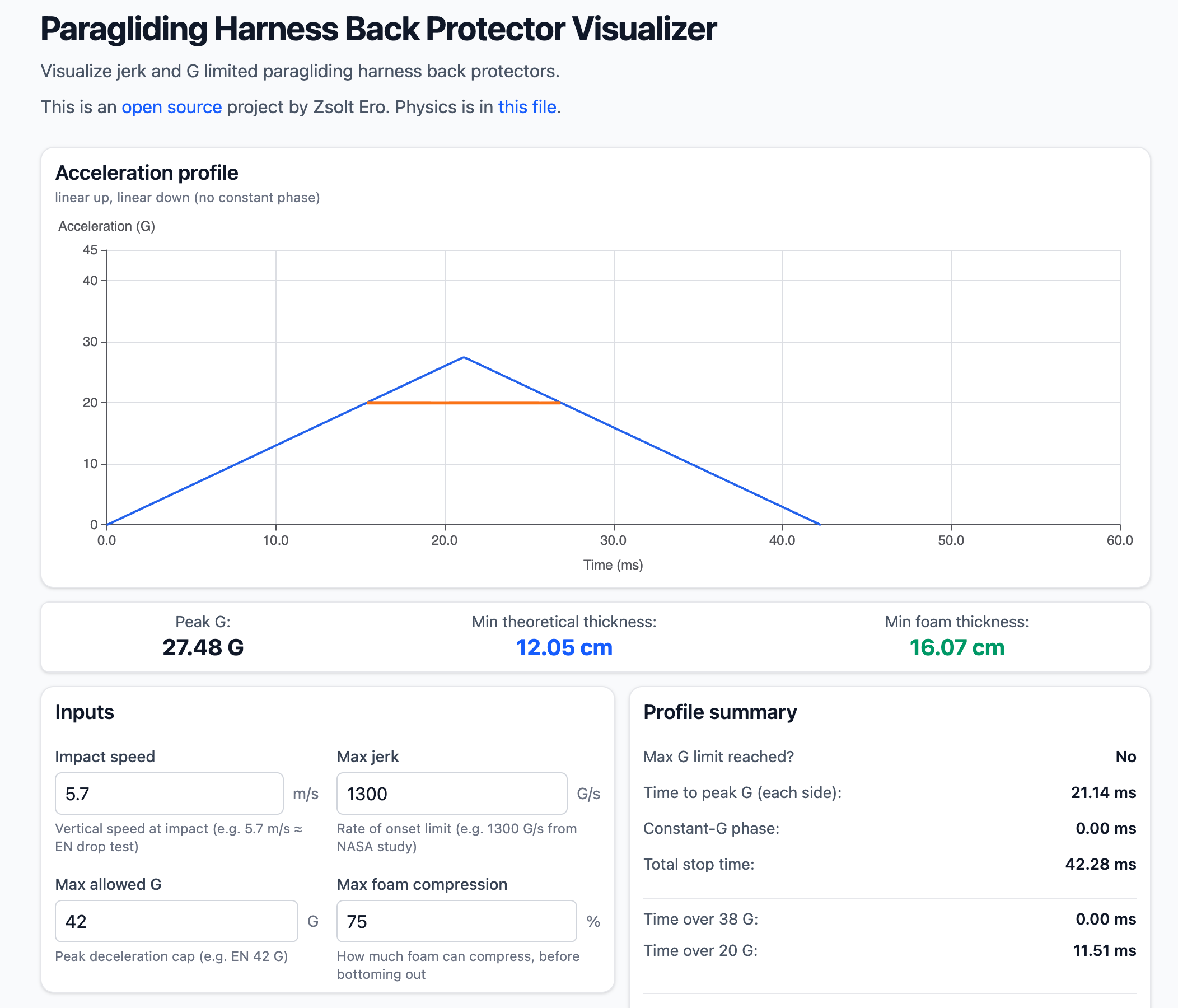
The new, corrected results were enlightening. It turns out I had underestimated my calculations by almost a factor of two!
The correct results with the 1300 G/s jerk limit are actually in line with what many experienced pilots described as their feeling for a good protector:
The thinnest possible theoretical protector would be 12 cm.
A 75% compressible foam protector would be 16+ cm.
12-16 cm is way above the 5-6 cm protectors we have in the Submarines!
Drop Test Visualizer
To address the other points in Fred’s article - namely that measuring jerk is difficult - I made another interactive tool. This allows visualizing, filtering, and calculating jerk on drop test CSV files used by manufacturers and test centers.
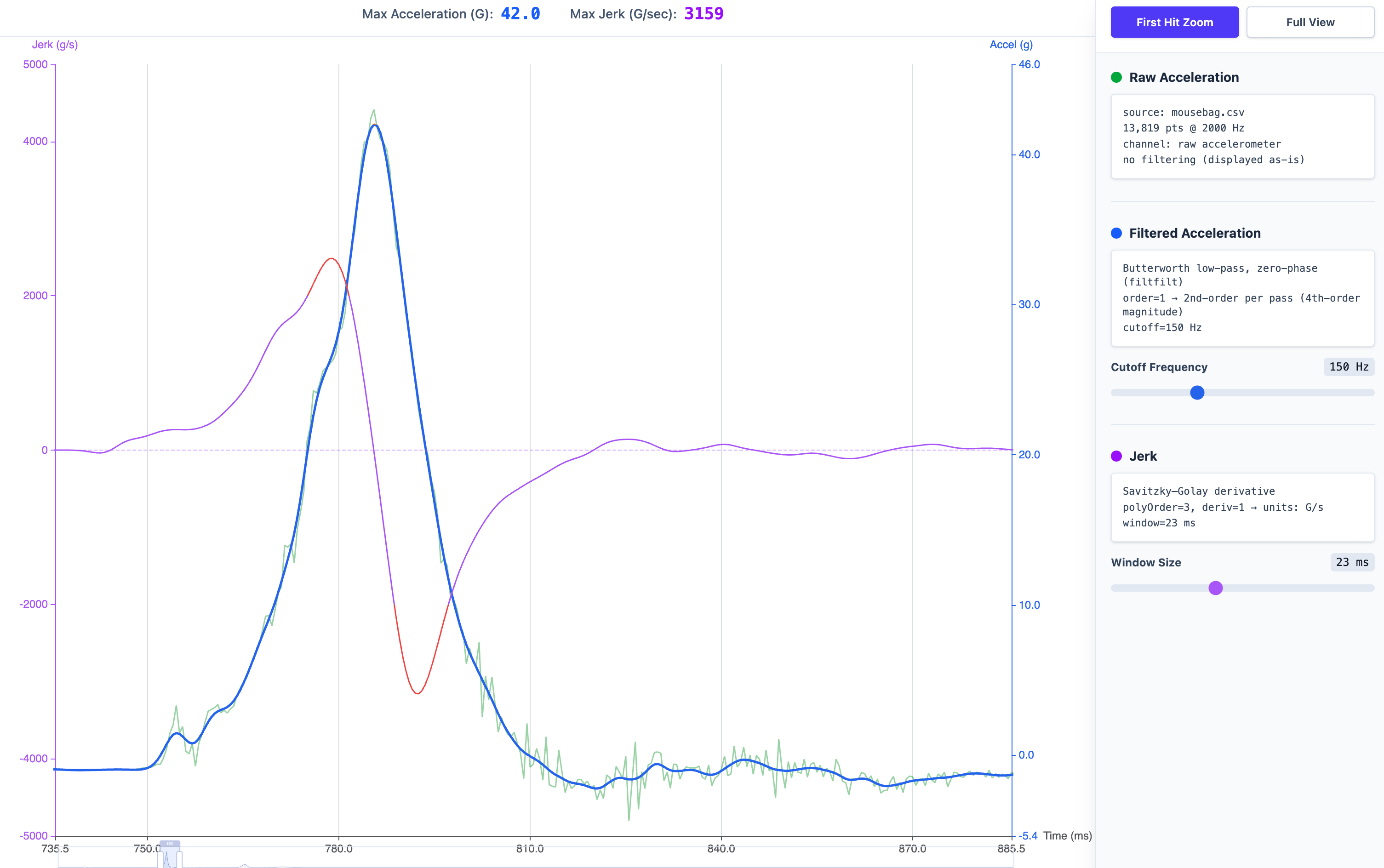
I believe that measuring acceleration and jerk using these filters is a solved problem. The acceleration filter I chose is the industry-standard filter for accelerometer sensors in the automotive crash-test industry (called a CFC filter).
What is visible in the screenshot above:
Green: Incoming noisy accelerometer data.
Blue: The filtered accelerometer data - this is the key, showing that filtering works perfectly!
Purple: The calculated jerk value over time - as you can see, this is also a clean, noise-free curve!
We can definitely use these filters to make correct and repeatable jerk measurements; there is no problem here. As an added bonus, there is no financial investment required for manufacturers or test centers. This is a software-only solution compatible with their existing systems.
You can try it on droptest.hyperknot.com with any of Fred’s sample files: Sample 1 and Sample 2.
Methodology
This section outlines my research limitations and the data collection process.
Resource Constraints
As an independent researcher, my sources were restricted to:
Friends sharing their experiences
Old posts on paraglidingforum.com
By “old”, I refer to the decline of paraglidingforum.com following the migration of online communities to Facebook. While active Facebook groups exist, their posts lack the detail and structure of earlier forum discussions.
The European Hang Gliding and Paragliding Union (EHPU) likely maintains protector data in its accident database, but it remains:
Non-public
Likely lacking the granular detail regarding Koroyd tube deformation that enthusiast pilots share on forums
It would be incredibly important for CIVL or the Free Flyers Union to enable pilots to submit protector-related incident reports so we can maintain an up-to-date dataset. Since 1.65 meter impact testing on humans is off the table, real-world incident reporting is the only way we can keep improving our protector standards.
Data Collection
I downloaded 3,350 posts from 14 paraglidingforum.com topics:
I used AI tools to analyze every accident report made by pilots in this dataset. In total, there were 20 detailed accident reports related to back-protector behavior. These reports are described in the following section.
Koroyd Injuries
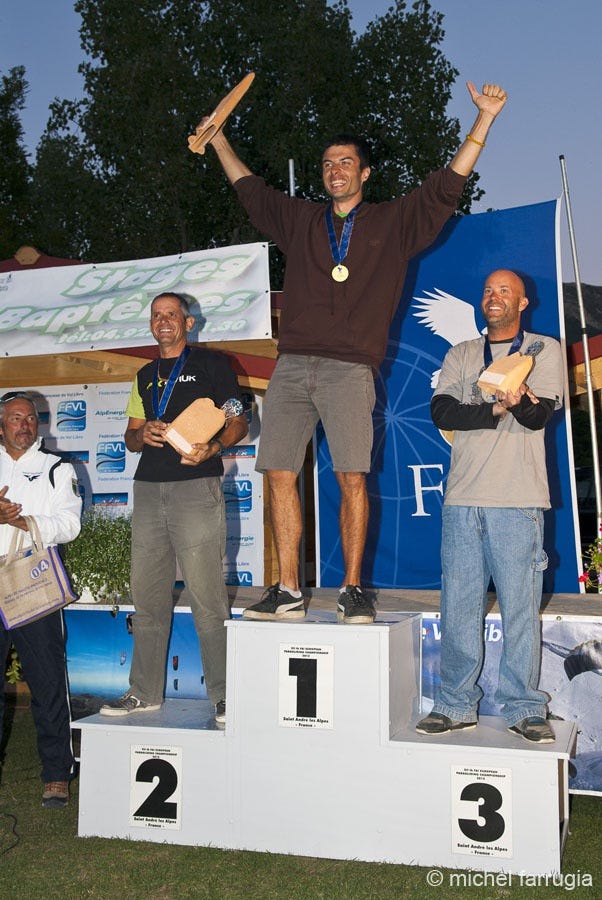
OK, let’s start with Yassen Savov. Everyone knows him; he is a former European Champion.
He posted publicly on the Free Flyer’s Union:
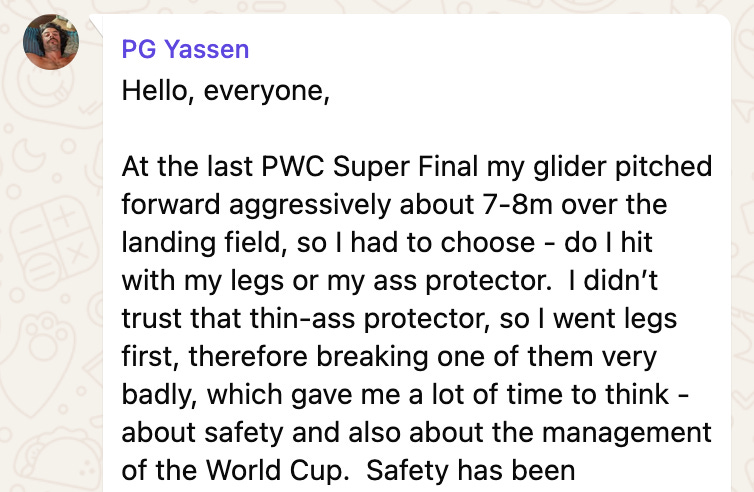
Was he making the correct choice? Let’s see.
Pilot 1
Lightweight female pilot at the Brazil World Championships, flying a Genie Race 5. Landed on a lee-side in a massive sink. Hit the ground legs-first, buttocks second.
Fractured L1 and T12 vertebrae. Still recovering, has to wear a corset - even though the Brazil World Championship started at the end of August and now it’s December.
But the shocking thing is that after such a crash, the Koroyd tubes were still intact! Some of them shifted horizontally, showing the impact had a horizontal component as well.
Pilot 2
Pilot’s legs got stuck because of Submarine zippers, landed on his buttocks on soft grass terrain.
Result was an L1 vertebra compression.
He believes landing on a foam protector from a previous-generation race harness would have been a non-issue!
Koroyd Mechanism
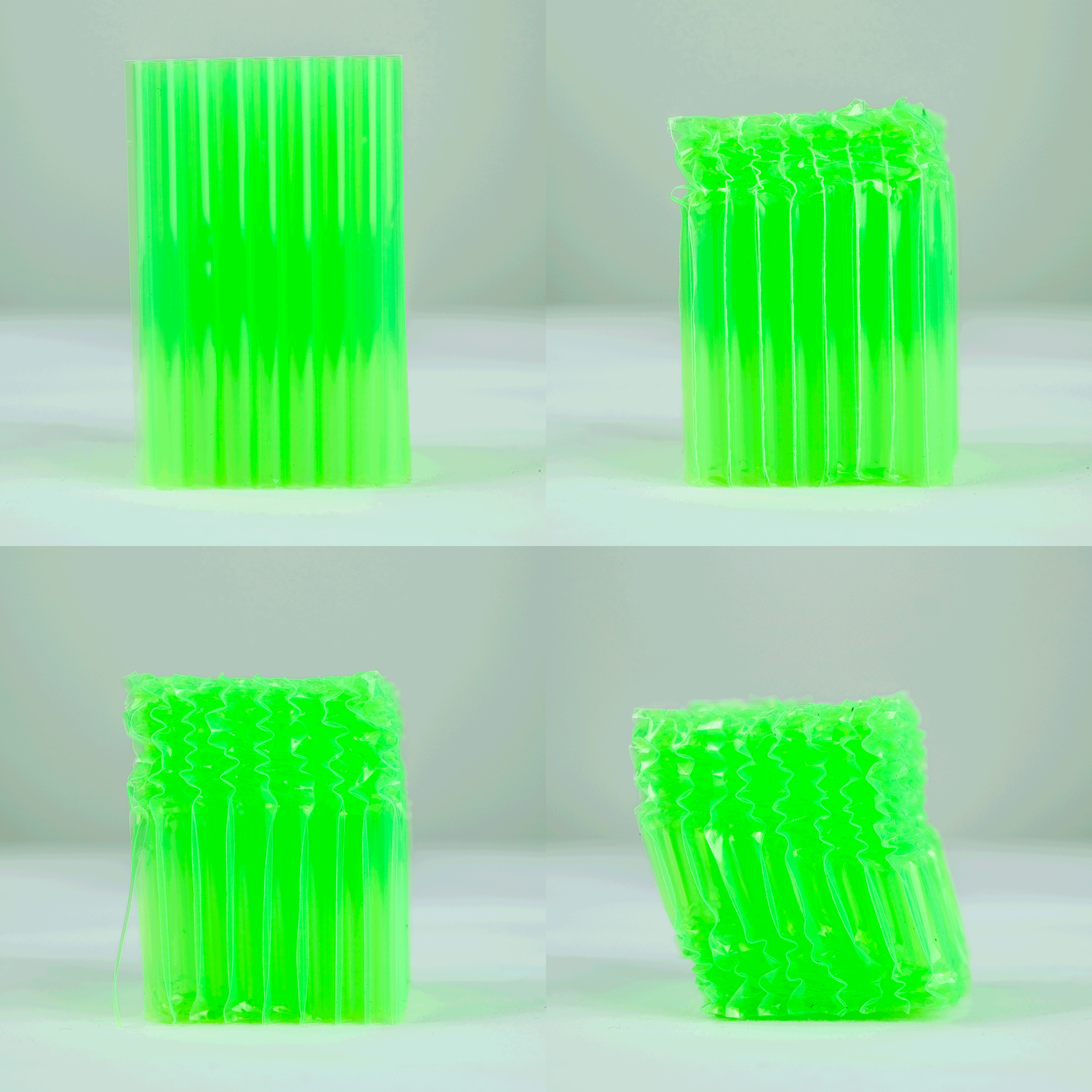
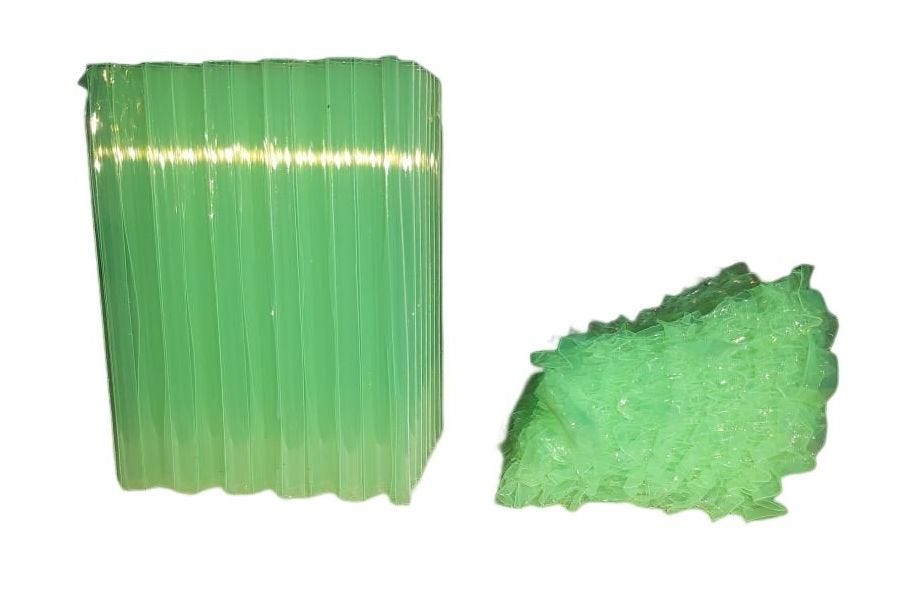
Let me stop for a moment and explain how Koroyd is supposed to work. Unlike any “spring-like” protector, such as foams or airbags, Koroyd dissipates energy by getting destroyed / crumpled. It is essentially a single use material.
This is how it is supposed to crumple - from the original marketing website.
And this is from DHV:
Meanwhile, we get reports like this, showing totally intact Koroyd tubes after extremely serious crashes at 10 m/s!
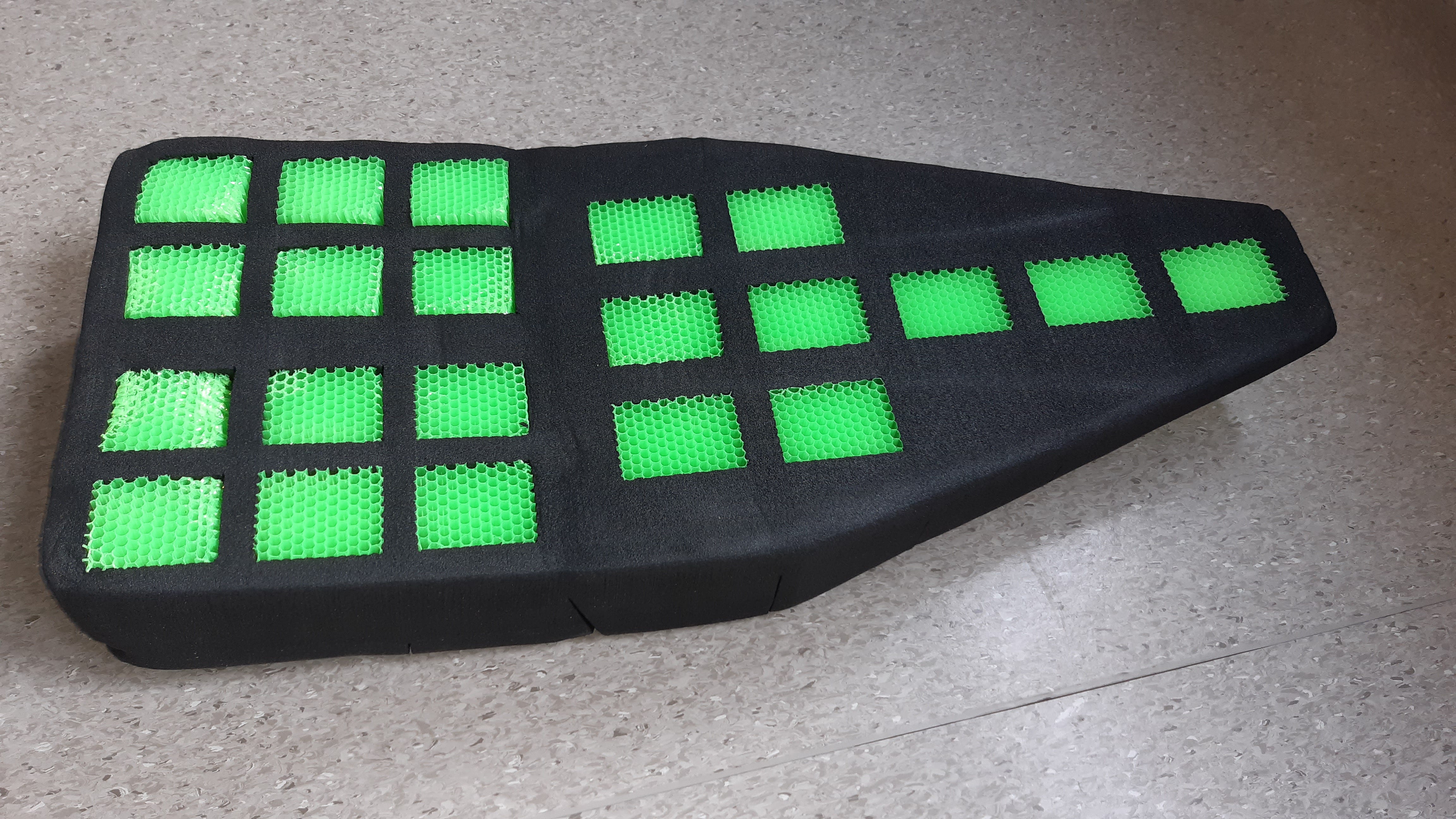
This photo is from an accident of pilot “Lukske”, detailed in the next section. It is a very serious, 10 m/s fall recorded by the vario, resulting in serious long-term injury to the pilot.
Yet, the Koroyd is 100% intact! (The small deformation on the left was already present before the accident.)
What we can conclude with 100% certainty is that when Koroyd looks like this after a crash, it did not work as intended. No matter what we measured in our laboratory drop tests, in the real world it behaved completely differently.
The crazy thing is that this happened in a Genie Race 4. These reports were published well before the Submarine and Genie Race 5 even came to market!
So let’s go to the paraglidingforum.com posts, starting with the detailed report of the same pilot.
Koroyd - Negative Experiences
Lukske
Date: Oct 1, 2022
Equipment: Gin Genie Race 4
Impact description: After a mid-air collision from 50–70 m, the pilot deployed a reserve. The landing was “hard, flat on my back, maybe more on my behind”. The vario showed a maximum sink of 10.3 m/s. The pilot confirmed he was “still sitting upright in my harness because of the straps of course, so not ‘pushed past the Koroyd protector’”.
Injury/damage/recovery:
Crushed vertebra T12 with severe neurological damage: “I fractured one vertebra in my back with paralysis in my pelvic area and legs.”
“After the operation I was left with a neurological injury at the level of L5-S1, with multiple paralysis symptoms in the pelvis and legs”
Long‑term outcome: persistent paralysis in parts of legs and pelvic region; walking only with crutches.
Protector condition: Essentially undeformed despite high‑energy impact. Later photos showed only very slight pre‑existing dents from sitting/parawaiting.
Quotes:
“The koroyd wasn’t even deformed.”
“The little deformation of the Koroyd was already visible before, as a result of sitting in the harness, parawaiting.”
“From T12, the nervous system branches between the successive vertebrae, the so‑called ’horsetail’… hamstrings and abductors partial, the calfs and toes completly, as well as my pelvic area with the sanitary problems… Luckily my quadriceps are still ok, so I can walk with crutches. In my feet I have nerve pains.”
Oakley
Date: Jun 2, 2023
Equipment: Gin Genie Race 4
Impact description: Following a cravat, the pilot flew into a forest, fell through trees and crashed onto his back. “Slightly feet up hitting a rock on the back of my head that pitched my head forward.”
Injury/damage/recovery: 4 broken ribs, a small pneumothorax, and 3 transverse fractures of the lumbar spine (L1-3), in addition to facial injuries.
Protector condition: Intact. “still intact after the accident and not really showing any sign of the impact.”
Quotes:
“All of this with the Race 4 and Koroyd protector still intact after the accident and not really showing any sign of the impact.”
“This is a shocking finding to me as the protector could have saved me, but somehow was not doing what it was supposed to do.”
Links: link1
PonchoelPiloto
Date: Jan 20, 2024
Equipment: Gin Genie Race 4
Pilot weight: 56 kg
Impact description: Stalled into trees and then fell to the ground. “I hit the ground falling almost straight down vertically while sitting back in the...harness in the normal in-flight position”. Vario showed a vertical speed of at least -3.3 m/s.
Injury/damage/recovery: Fractured L1 vertebra. Recovery involved a back brace for a few months with no surgery required.
Protector condition: Intact. “the Koroyd back protector came out intact in spite of falling directly on it.”
Quotes:
“Sharing details about my recent crash which resulted in a fractured L1 vertebra, in which the Koroyd back protector came out intact in spite of falling directly on it. Is this normal?”
“I am surprised that with a force that was strong enough to fracture a vertebra, the Koroyd foam appears completely intact.”
“I’m lucky that my nerve function is intact and I most likely will not need surgery.”
“This is why I’m sharing my accident.”
Links: link1
Nick Neyens’ Incident (discussed by forum members)
Date: Oct 13, 2022
Equipment: Harness with Koroyd protector
Impact description: A high-energy crash resulting from a flying incident.
Injury/damage/recovery: Severe spinal injury resulting in paralysis.
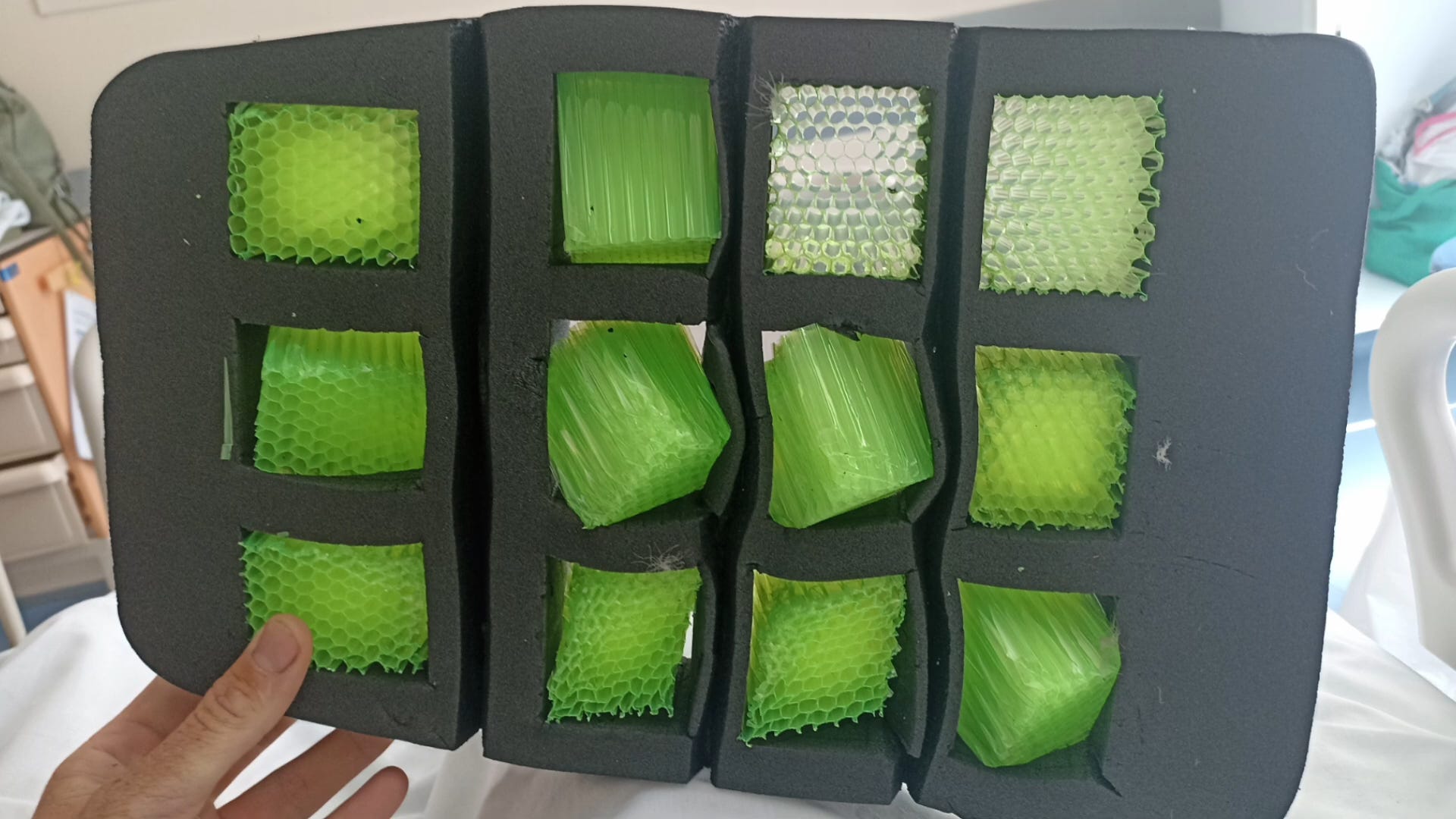
Protector condition: Observers noted the protector was largely intact but showed some signs of non-vertical impact.
Quotes:
“Here it seems to be just twisted a bit sideways, and somewhat crumpled diagonally, i.e. not in the direction that would be best for taking the impact.”
“Yet on Nick Neyens’ video… the post‑impact protector shows that the Koroyd piece isn’t crumpled. It does look almost pristine, meaning it looks like it simply didn’t do its job.”
THG
Date: Nov 27, 2022
Equipment: Gin Genie Lite 3
Impact description: On landing approach, the pilot hit the edge of a ditch. The impact occurred at an angle on the right thigh.
Injury/damage/recovery: A broken spine. The pilot wore an orthopedic corset for 2 months and returned to full fitness after 3 months.
Protector condition: Dented very little. “On the board you can see the place of impact, you can compare it to the protector, which dented slightly.”
Quotes:
“I was already out of my harness, and the Koroyd protector in the Gin genie lite 3 did not help.”
“The harness didn’t suffer and the protector dented very little.”
“I would not buy a harness with Koroyd protector a second time.”
Koroyd - Positive Experiences
There was only a single positive experience with Koroyd. Notably, in this pilot’s case, the Koroyd crumpled as intended: 3 modules were crushed.
MarcBoyer (witnessed)
Date: Nov 15, 2023
Equipment: Harness with Koroyd protector
Impact description: A pilot hit the ground “violently” in a seated position following a spin and pendulum recovery.
Injury/damage/recovery: No injury.
Protector condition: Partially crushed. “The Koroyd warped over 3 honeycomb modules.”
Quotes:
“This pilot hit the ground in a seated position. The Koroyd warped over 3 honeycomb modules.”
“The pilot walked up the slope to the ridge. He took off again and then flew 3 hours”
Links: link1
Inflatable Airbags
Finally, I’d like to collect the same accident reports for full-size inflatable airbags.
By full-size, I mean those like the Skywalk Range X-Alps series that cover the spine, looking like this:
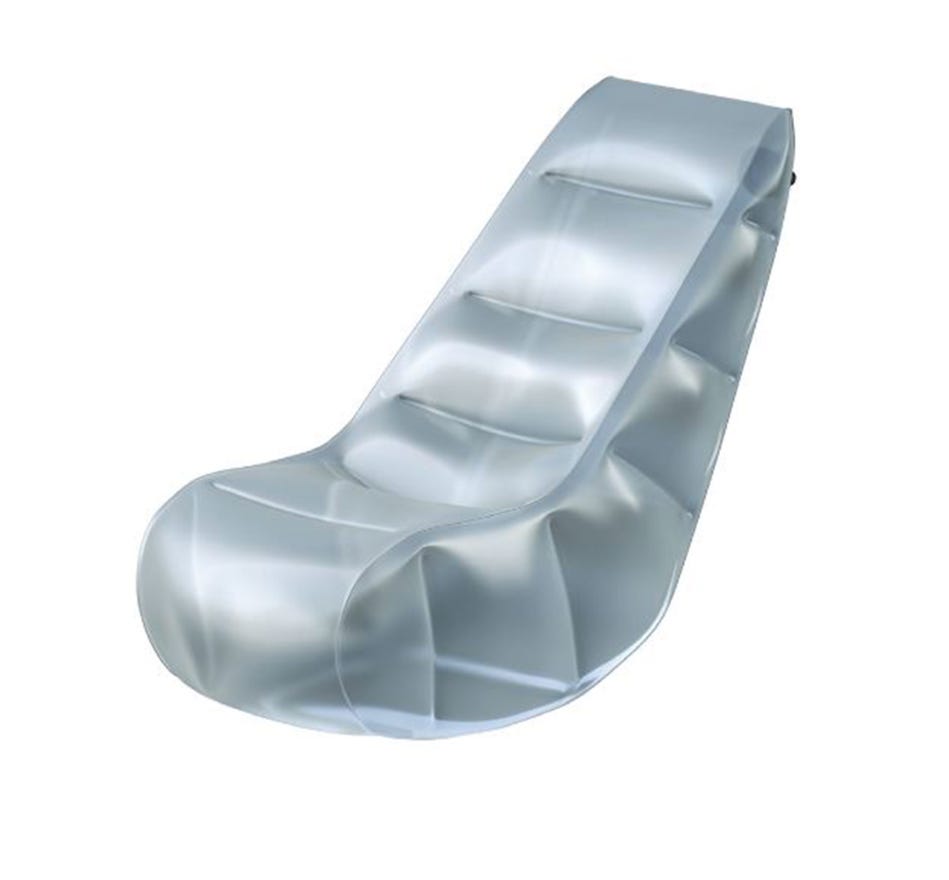
These reports are especially important because the enthusiastic pilot community right currently believes that these are the safest protectors on the market today.
Yet, every harness manufacturer I’ve contacted believes that inflatable airbags are inherently bad because they do not pass some time-based test. For example, none of these protectors would pass a “20 ms over 20 G” criteria, something that Koroyd has no problem with.
They also happen to bounce on the drop-test machine, yet in the real-world we’ll see that bouncing is a non-issue.
Summary
lighthunt – Crashed at ~10 m/s in a Karpofly harness while twisted, walking away uninjured.
mincek – Stalled a Skywalk RXA3 from 2–3 meters, resulting in severe bruising but avoiding hospitalization.
tomc – Fell 2 meters onto gravel in a Skywalk RXA2 during a tree landing, escaping with only a minor wrist sprain.
Ismail – Experienced a hard landing on his buttocks in sink on a Skywalk RXA2, noting the impact felt “soft and cushy” compared to traditional foam.
AliF – Landed hard on a slope in a Karpofly harness and bounced sideways into nettles but reported no injuries.
Florian33 – Sustained leg injuries during a severe crash in a Karpofly harness, but the protector prevented spinal damage and showed no bounce.
Bpw – Suffered a slight compression fracture in a Skywalk RXA2 after a very hard impact that burst the protector and blew the harness apart.
inigo – Walked away uninjured from a hard landing in a Skywalk RXA2 that damaged the protector and ripped the harness.
Born2Fly – Remained uninjured after a rough impact in a Skywalk RXA2 and continued using the harness for two years.
flyingdawg – Put a Skywalk Range Air through “hell,” including two crashes, with no injury to himself or damage to the gear.
uBaH – Avoided back injuries over two years of bad landings on rocks and thorns while flying a Karpofly harness.
cuiv (witness) – Witnessed two pilots spin to the ground from 4 meters on air protectors, observing no bounce and no injuries.
LordRuthven (witness) – Watched a pilot slam into a slope in a Karpofly harness and emerge completely unharmed except for a scratch.
In detail
Note: if you want to skip the detailed reports, feel free to jump directly to Conclusion at the end.
1. lighthunt
Date: Dec 6, 2025, Youtube comment to my recent interview on Paragliding Atlas
Equipment: Karpofly harness
Impact description: The pilot crashed while “twisted locked in autorotation” and hit a hard field at approximately 10 m/s (verified by flight log). The heavy impact was distributed along the “banana shape” protector from buttocks to neck.
Injury/damage/recovery: The impact “knocked the breath out” of the pilot but they suffered no physical injuries. They were able to walk away and flew an XC flight back the same afternoon. The pilot believes they “would not walk” if they had been using a foam protector (citing a previous tailbone injury with an 18cm foam protector from a smaller impact).
Protector condition: The protector functioned correctly during the crash.
Quotes:
“I have crashed twisted locked in autorotation and hit the hard field at ~10m/s according to the log and walked away from it.”
“Physically the impact knocked the breath out of me for a while... but I am forever grateful I’ve chosen safe harness with proper thick (17cm) banana shape airbag.”
“I am sure, I would not walk if I was sitting in anything else (I hurt my tail sitting in 18 cm foam protector from much smaller impact earlier).”
Links: link1
2. mincek
Date: Jul 4, 2023
Equipment: Skywalk Range X-Alps 3
Impact description: 90 kg pilot stalled the wing from approximately 2–3 m above ground, resulting in a “fairly big bang on my back”. The impact sequence was “ass/upperback first, top body next and feet last”.
Injury/damage/recovery:
Reports “bruised ass and pain in tail bone” and being “sore for few weeks,” but no hospital stay or diagnosed fractures.
He explicitly believes the protector prevented much worse injury: “That protector probably made a difference in me being in hospital vs me being sore for few weeks.”
Protector condition: Intact. The “Protector survived it and did not burst into pieces.”
Quotes:
“I had a fairly big bang on my back in RXA3. Need to say that the protector probably saved me from more serious injuries. Bruised ass and pain in tail bone is all I got.”
“Protector survived it and did not burst into pieces.”
“That protector probably made a difference in me being in hospital vs me being sore for few weeks.”
3. tomc
Date: Apr 2, 2020
Equipment: Skywalk Range X-Alps 2
Impact description: Tree‑tip landing leading to a short uncontrolled fall onto his back. He describes a horizontal rotation and drop of about 2 m onto a gravel road.
Injury/damage/recovery: He reports only a minor wrist sprain and otherwise walked away.
Protector condition: The harness sustained structural damage. The protector itself was undamaged.
Quotes:
“Couple of weeks ago I had a tricky landing tipping the top of trees. The result was a fall with horizontal 360 rotation from about +2m straight on the protector.”
“It felt OK, just a bit harder at the very end of the impact. I had no injury except for a minor sprained wrist.”
“Compared to the Gin Genie Race protector, which feels very progressive protecting in the same case, the air protector feels soft till a certain point. This makes all sense as the air cannot get out.”
4. Ismail
Date: Sep 17, 2018 (Incident) / Jan 17, 2023 (Retrospective)
Equipment: Skywalk Range X-Alps 2
Impact description: A hard landing on the buttocks in a tight spot. The pilot was lifted by a thermal and then hit strong sink close to the ground. In later posts, he refers to this and other “unintended hard impacts” over his time flying the harness.
Injury/damage/recovery: No injuries reported. The pilot emphasizes that he “just got up, packed and went off for the second flight.” He explicitly compares this to foam protectors, stating a belief that he “probably would have broken something” or had a sore back for a week if using traditional foam.
Protector condition: Intact. The pilot described the impact as feeling “soft and cushy,” likening it to “plopping on a couch.”
Mechanics observed: He noted that upon impact under the seat, the air redistributes to the back and sides. This inflation of the surrounding areas cushions the secondary impact on the upper spine/back as the pilot rolls backward.
Quotes:
“The sink was just too big and unfortunately a hard butt landing followed... With any other back protection I probably would have had a sore back for a week but with this guys I just got up, packed and went off for the second flight.”
“Later on when switched to Skywalk X-Alps 2, I noticed that unintended hard impacts were way way more soft and injuries were avoided where I probably would have broken something if it was just a regular foam based back protection.”
“The way the PermAir dissipates the blunt impact is quite interesting... the air that just moments ago was squeezed under you does travel sideways and upward, making the secondary impact on your upper spine much less noticeable.”
Links: link1, link2, link3, link4
5. AliF
Date: Sep 27, 2020
Equipment: Karpofly harness
Impact description: Described as having “landed hard on the harness once which was on a steep slope after a low spin”. The impact caused one bounce, which “threw me sideways into a nettle patch”.
Injury/damage/recovery: The pilot reported “no problem”.
Quotes:
“So far I only landed hard on the harness once which was on a steep slope after a low spin.”
“I did get one bounce which threw me sideways into a nettle patch, no problem but I guess you could get thrown over sideways and land on a shoulder or face with second bounce.”
“Still the first bounce will always be the hardest.”
Links: link1
6. Florian33
Date: Dec 6, 2019
Equipment: Karpofly harness
Impact description: Very hard impact onto the protector in standing posture. Some energy was taken by his legs but most went into the back protector.
Injury/damage/recovery: Significant soft‑tissue trauma to the legs but no fractures; spine spared despite a crash that witnesses expected to be fatal.
Protector condition:
Airbag valve remained closed; no bounce was observed.
No damage to the airbag was reported; he concludes that it “works just perfectly.”
Quotes:
“I (unfortunately) tested the (fortunately) excellent Karpofly airbag in real conditions. The accident itself is irrelevant here but the impact isn’t: I was standing, therefore some of the energy (not much) was absorbed by my legs (leading to serious tendon and muscle injuries, but miraculously no bone was broken), and the rest of the strong impact occured on the protection.”
“In short, the Karpofly protection works just perfectly.”
“I didn’t bounce, the valve stayed closed and my spine didn’t break.”
“All of the eye (and ear) witnesses … thought I was dead or at least wouldn’t lift up (ever...).”
Links: link1
7. Bpw
Date: Sep 24, 2024
Equipment: Skywalk Range X-Alps 2
Impact description: A very hard hit on smooth grass. “I used my legs, and blew through a protector... Pretty common to go legs then butt when you fall down.”
Injury/damage/recovery: A “slight compression fracture”.
Protector condition: Protector burst under load, but only after significant deformation: “I managed to burst the protector on my RXA2, but it was a really, really hard hit, and the protector took a lot of energy before popping, blew the harness apart as well.”
Quotes:
“I also made it through with nothing worse than a slight compression fracture, so the gear seems to have done its job.”
Links: link1, link2, link3, link4, link5
8. inigo
Date: Nov 3, 2024
Equipment: Skywalk Range X-Alps 2
Impact description: Hard landing
Injury/damage/recovery: The pilot was uninjured. “I am pretty sure that with another protection I would had have more chances of being injured.”
Protector condition: Protector damaged, harness “ripped” from the impact.
Quotes:
“My experience with Perm-air protection was under a Range Xalps 2 harness.”
“Some years ago I had a bad and hard landing, and the protection did its work. Of course, protection got damaged and the harness was ripped. But I did not get any injury.”
Links: link1
9. Born2Fly
Date: Jan 26, 2023
Equipment: Skywalk Range X-Alps 2 with Permair protector
Impact description: Describes “a quite rough impact on a tight landing” with the RXA2, hard enough that he feels the protector “saved” him.
Injury/damage/recovery: No injuries mentioned; he implies he walked away from the impact and kept flying the same harness.
Protector condition: He continued using the harness for about two years and reports no problems with the protector, implying it stayed intact and functional after the hit.
Quotes:
“I was flying the RXA2 for about 2 years and didn’t have a problem. It even saved my **s during quite rough impact on a tight landing.”
Links: link1
10. flyingdawg
Date: Mar 13, 2018
Equipment: Skywalk Range Air
Impact description: Mentions two crashes but gives no specifics about height, surface or body position: “I put my Range Air through hell, including two crashes…”
Injury/damage/recovery: No injuries are reported in the post.
Protector condition: Harness (including the airbag system) survived both crashes without any visible damage according to the pilot.
Quotes:
“I put my Range Air through hell, including two crashes, and it is as good as new.”
“I really couldn’t believe that it had no damage after my last crash.”
11. uBaH
Date: Sep 26, 2022
Equipment: Karpofly Fantom Extralight 2
Impact description: A summary of multiple small-to-moderate impacts over the first two years of flying. These included “Many bad or aborted takeoffs, many bad landings and some downwind landings on rocky terrain,” including on “thorns, bushes, stones, rocks.”
Injury/damage/recovery: “I have NEVER been injured in the back and NEVER felt any pain or discomfort after any of these situations.”
Protector condition: The protector remained functional through all impacts and a total of 7 seasons of use. The pilot described its performance as “outstanding.” No bouncing was observed. Non-impact-related wear on the valve and hose occurred over time and was repaired.
Quotes:
“In the first two years mainly I have ‘tested’ the inflatable protector many many times. Many bad or aborted takeoffs, many bad landings and some downwind landings on rocky terrain.”
“I have NEVER been injured in the back and NEVER felt any pain or discomfort after any of these situations. The protector did its job in a perfect way.”
“Many times landing on the protector, on thorns, bushes, stones, rocks. The inflatable protection was outstanding.”
12. cuiv (witness)
Date: Sep 18, 2022
Equipment: Unspecified harnesses with “air protectors”.
Quotes:
“I’ve personally witnessed 2 pilots suffer strong impacts on air protectors (spin to ground from 4 meters high or so), but there was no bounce (a big sound though)... And no injury either.”
Links: link1
13. LordRuthven (witness)
Date: Jul 23, 2019
Equipment: Karpofly X‑Alps 3
Impact description: He watched another pilot “trying to thermal too low and too close to the slope” who then “slammed directly into” the hillside. He characterizes it as “a hard and nasty smack” directly into the slope.
Injury/damage/recovery: The pilot was “completely unharmed” apart from “a small scratch on his leg near the boot”.
Quotes:
“The first time I saw it in action was when a guy who was trying to thermal too low and too close to the slope slammed directly into it near Karlovo with Karpofly X-Alps 3 open harness.”
“It was a hard and nasty smack, but apart from a small scratch on his leg near the boot, he was completely unharmed.”
Links: link1
Foam Protectors
Foam protectors are generally taken as the standard and are not discussed as frequently as Koroyd or air protectors.
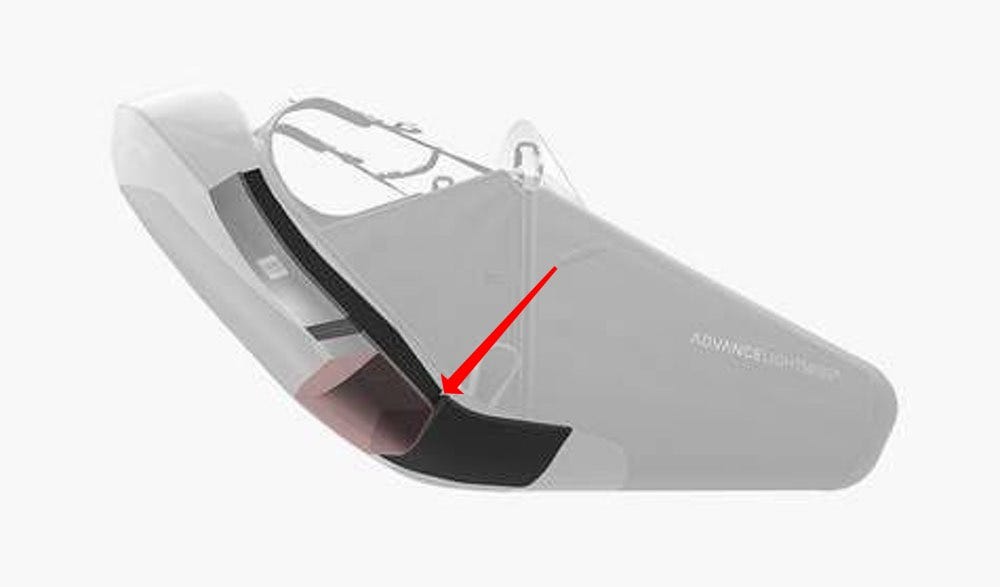
The only significant point worth noting here is that in some harnesses, instead of a full-size back protector, the rescue container is mounted in the lower back. In the first case below, the pilot broke his back exactly on the border between the protector and the reserve container. This configuration has long been criticized as a dangerous mounting point on lightweight harnesses.
1. cuiv
Date: June 2021
Equipment: Advance Lightness 3
Impact description: The pilot had a “bad landing in rotor” where the “impact wasn’t even that strong.” The harness hit the ground at the border between the foam protector and the rescue parachute container located in the back.
Injury/damage/recovery: An “exploded vertebra” resulting in a broken back and spinal fusion.
Quotes:
“The impact that broke my back was right at the border between the rescue and the protector. That meant the full energy transferred to my spine.”
“I am convinced (without proof) that had I been in my Wani Light 2 with its massive airbag protector, I wouldn’t have been hurt.”
“I see more and more harness manufacturers praising their own protector... a lot of ‘trust me bro!’ from the manufacturers... yet their design diagrams seem to indicate the rescue is placed within the protector area.”
2. JonesB
Date: Feb 15, 2024
Equipment: Kortel Kanibal Race 2 with the regular foam protector.
Impact description: A 64 kg pilot experienced a “hard landing” while flying in Colombia.
Injury/damage/recovery: The pilot reported no significant injuries, stating they were “good to go the next day.”
Quotes:
“regular foam protector works great.”
“Saved my back on hard landing and was good to go the next day.”
Links: link1
Conclusion
The most important points I’d like to highlight in conclusion are:
Koroyd
Koroyd has very different behavior in real-world conditions compared to the controlled drop‑test environment.
On the test bench, it crumples nicely. In real crashes, it very frequently stays almost intact while the pilot leaves with fractured vertebrae and, in several cases, long‑term neurological damage or paralysis.
Even during perfectly controlled drop tests, Koroyd already shows dangerously high jerk values. In the real world, with non‑vertical impacts, rotation, and uneven ground, pilots may have experienced extreme G and jerk values – easily multiple times higher than the lab‑measured ones.
In my small dataset alone, the real‑world behavior of Koroyd is associated with dozens of injured pilots, and I believe these reports might only cover 1–2% of Koroyd injuries.
Airbags
I believe full‑sized inflatable protectors are the safest protectors available today.
This is especially important because most manufacturers currently discard them as an inferior solution, largely because of how they perform against certain time‑based criteria on standardized tests. I’m especially worried that a new EN test with strict time‑over‑G requirements could effectively exclude inflatable airbags, despite their excellent real‑world record.
I collected all those reports to show that the real‑world behavior of inflatable airbags is probably better than anything else currently on the market.
It might be worth discussing the reasons for this. Some of my ideas:
They distribute the load smoothly over the full human body, without sharp pressure points.
They handle over‑loading (heavier pilots and/or higher impact speeds) much better than foam or Koroyd, without a hard bottoming‑out point.
Even in extremely high-energy impacts - the rare cases where protectors exploded - pilots mostly reported walking away with no or relatively minor injuries.
If we care about what happens in actual crashes, full‑size inflatable airbags should not be treated as second‑class solutions. They look a lot like the best we currently have.
The data gap
All of this sits on top of a massive data gap.
I had to scrape old forum threads and personal reports to get even this small dataset. EHPU almost certainly has useful information in its accident database, but it’s not public and likely lacks the level of detail pilots share when they post their own stories.
Right now, our standards are optimized for what is easy to measure on a drop test - not for what actually happens when a pilot hits the ground in a real crash.
It would be extremely important for CIVL or the Free Flyers Union to start collecting accident data specifically related to protector behavior. Since 1.65 m impact testing on humans is off the table, real‑world incident reporting is the only way we can keep improving our protector standards.
Hopefully this will come soon!
Bonus
I also share a NotebookLM project for those who would like to query this dataset. At that link, you can ask questions like: “Research all pilot discussion and especially personal experiences about inflatable protectors bouncing. Is this an issue, or not?”
Thanks for all your work!
In my opinion (from the outside) the main problem is that no-one like to take the responsible to make a decision against his own interests.
The manufacturer like to leave all what it was.
The Pilots are weak and think they are not in the position.
The testcenter just do their Job as it was done the last 20 years.
and the DHV or FAI don't see their own position within the working group.
Sometimes it's depressing and senseless to see how they act all together.
Even many pilots outside don't want to know the facts or just want to see better performing harnesses. But more than 80% of all Pilots don't fly competition at all!
They THINK all harnesses are somehow safe...
A new protector idea
https://m.youtube.com/watch?v=gLkxnPt2hE0