
About competition safety and how can CIVL improve

I’ve been collecting my thoughts on the paragliding competition world and the unfortunate, tragic accident of Bram Declercq at the World Championship in Brazil.
If you haven’t read it, here is CIVL’s official statement on the accidents. Accidents, in the plural, as unfortunately there was also a tragic accident at this year’s Hang Gliding World event.
An article on this topic from XCMag.com includes details from a third tragic accident at the PWC in Turkey as well. That’s three tragic accidents in high-level comps within 3 months!
Community reactions and proposals
Note: the following section mentions Pál Takáts and Julien Garcia, some of the most experienced and influential people in our sport - two people who I highly respect. Still, I disagree with their solutions, and I’ll explain why.
Pál Takáts
Pál Takáts wrote the following post on Facebook and Instagram.
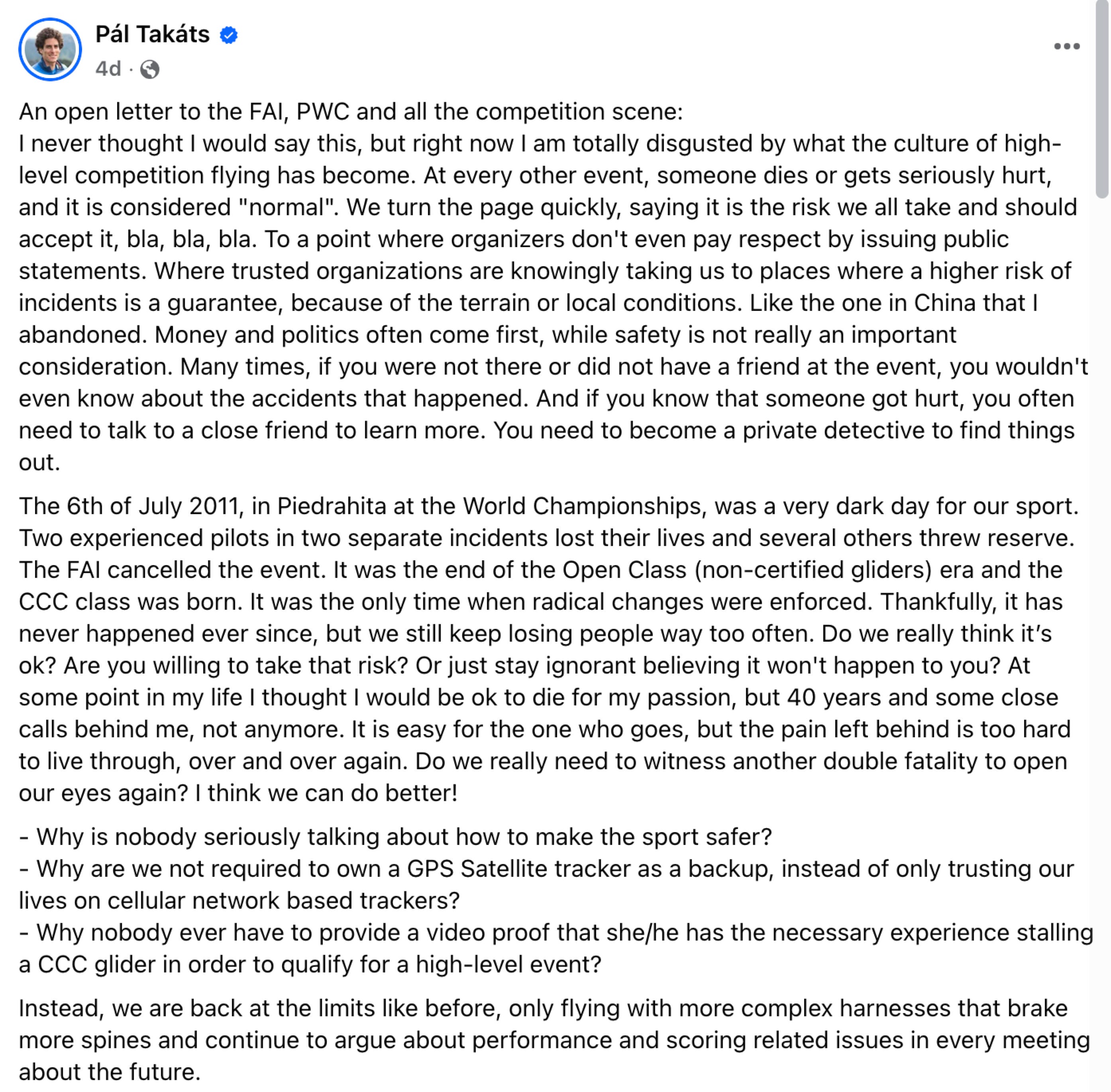
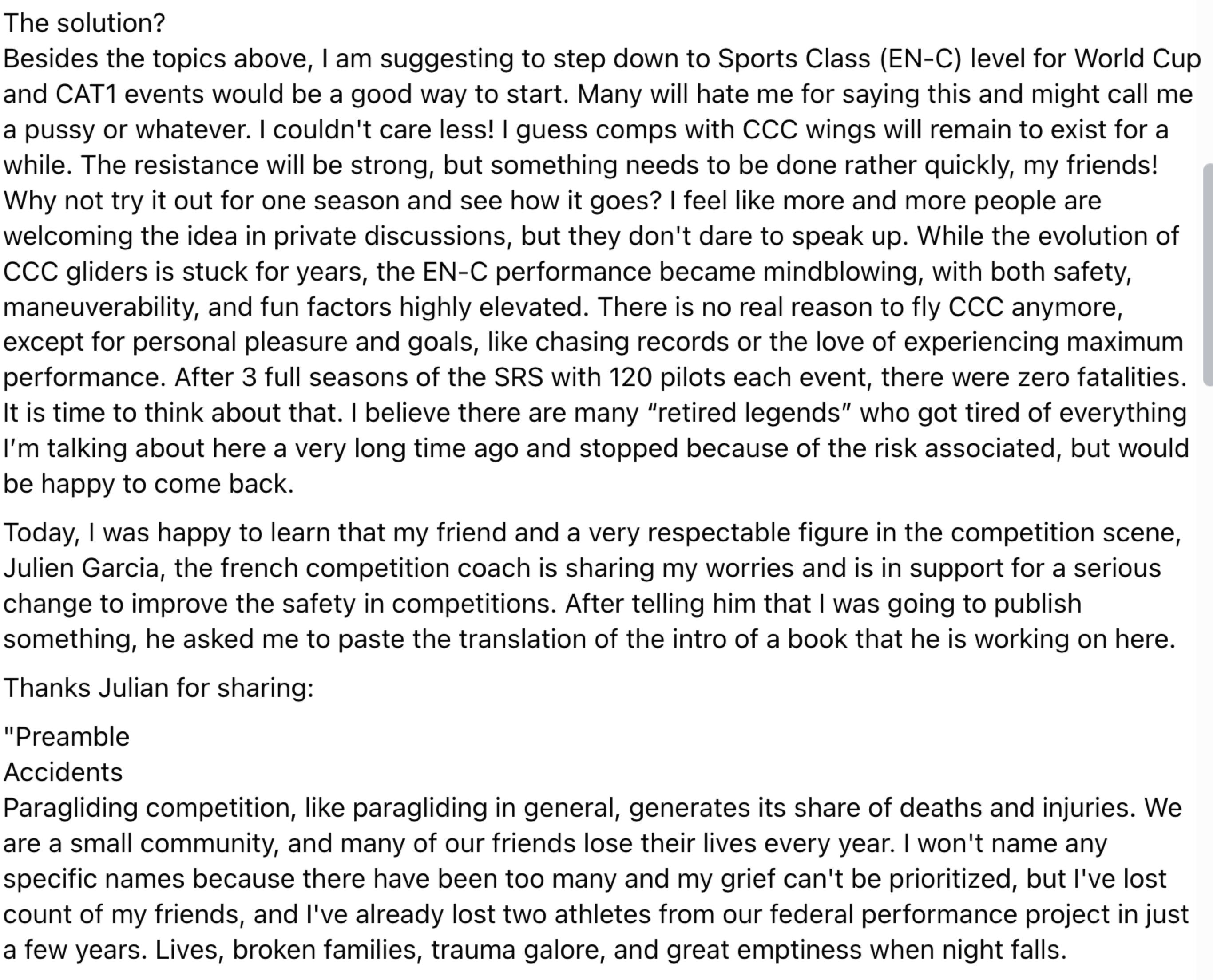
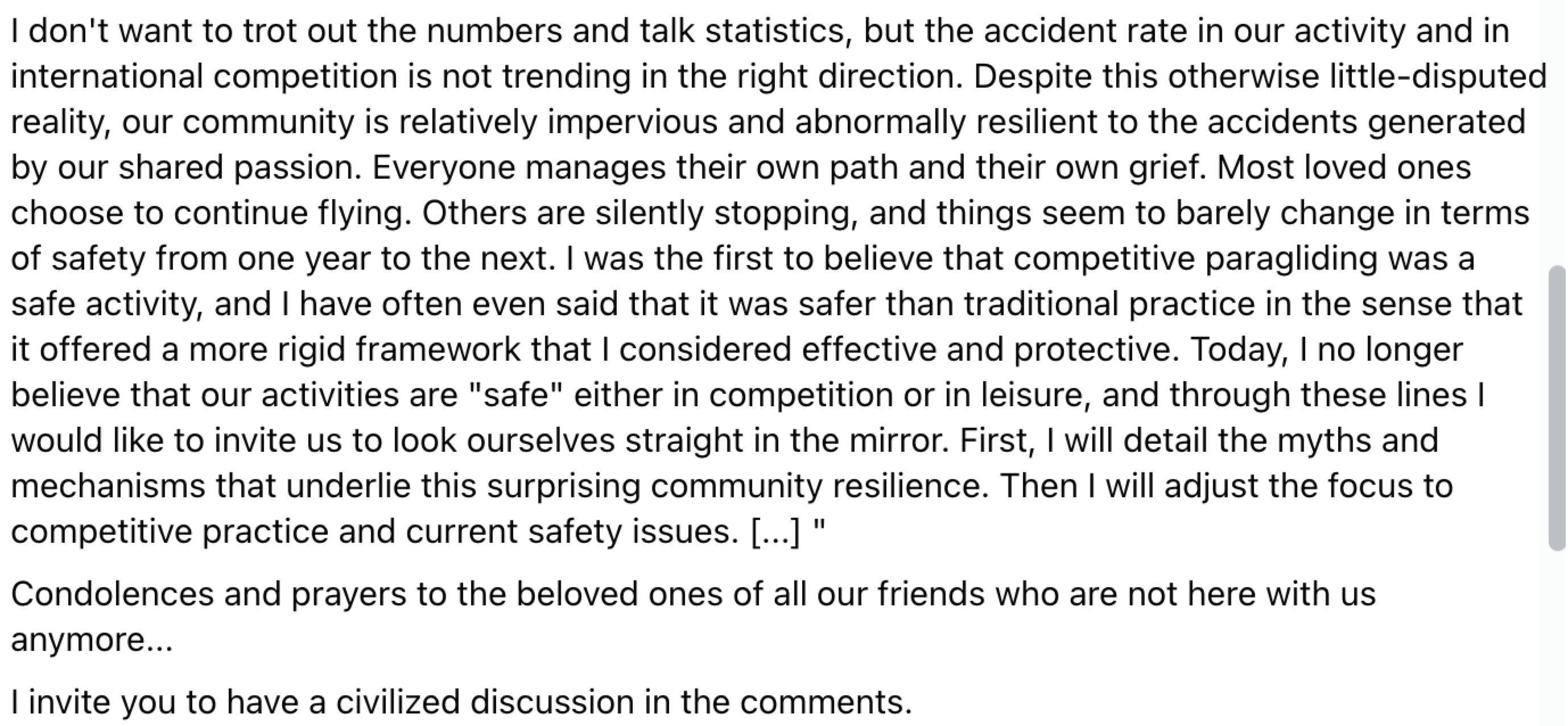
Pál later also published an update.
Marcella Uchoa
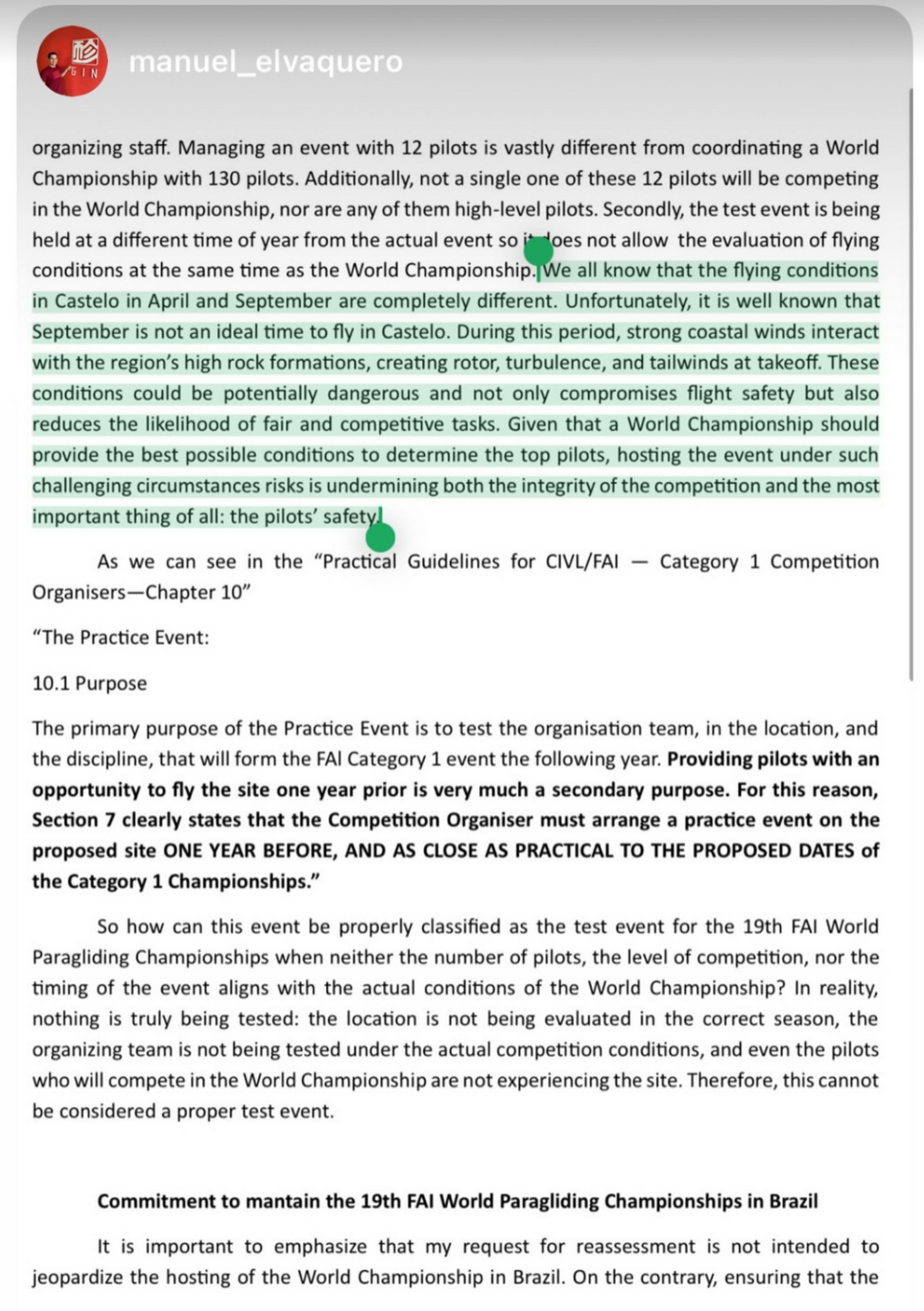
A letter was shared, which was sent by Marcella Uchoa back in April, that warned the organizers about the dangerous conditions that would be present in September. Unfortunately, his points turned out to be an extremely precise prediction (highlighted in green).
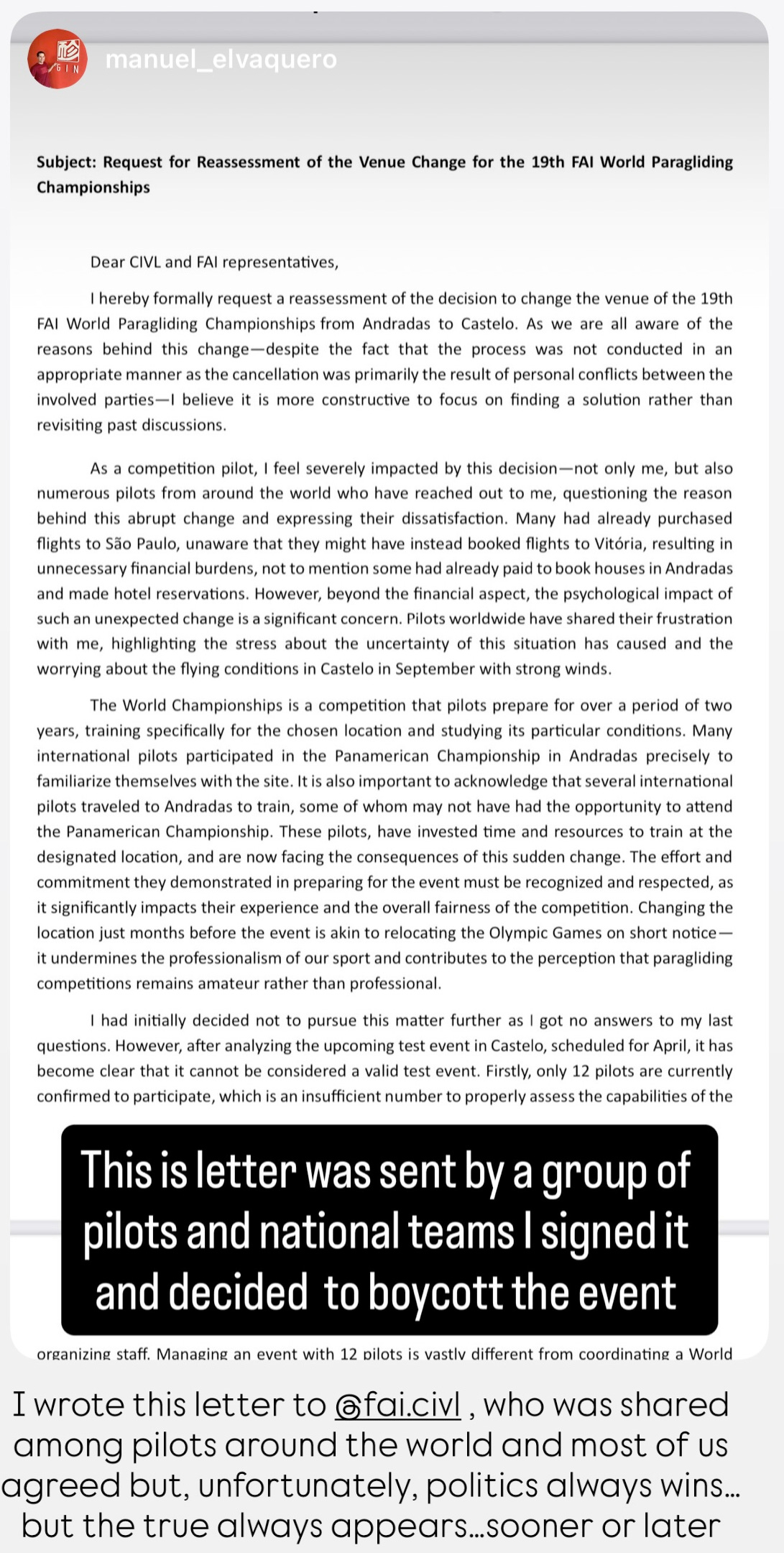
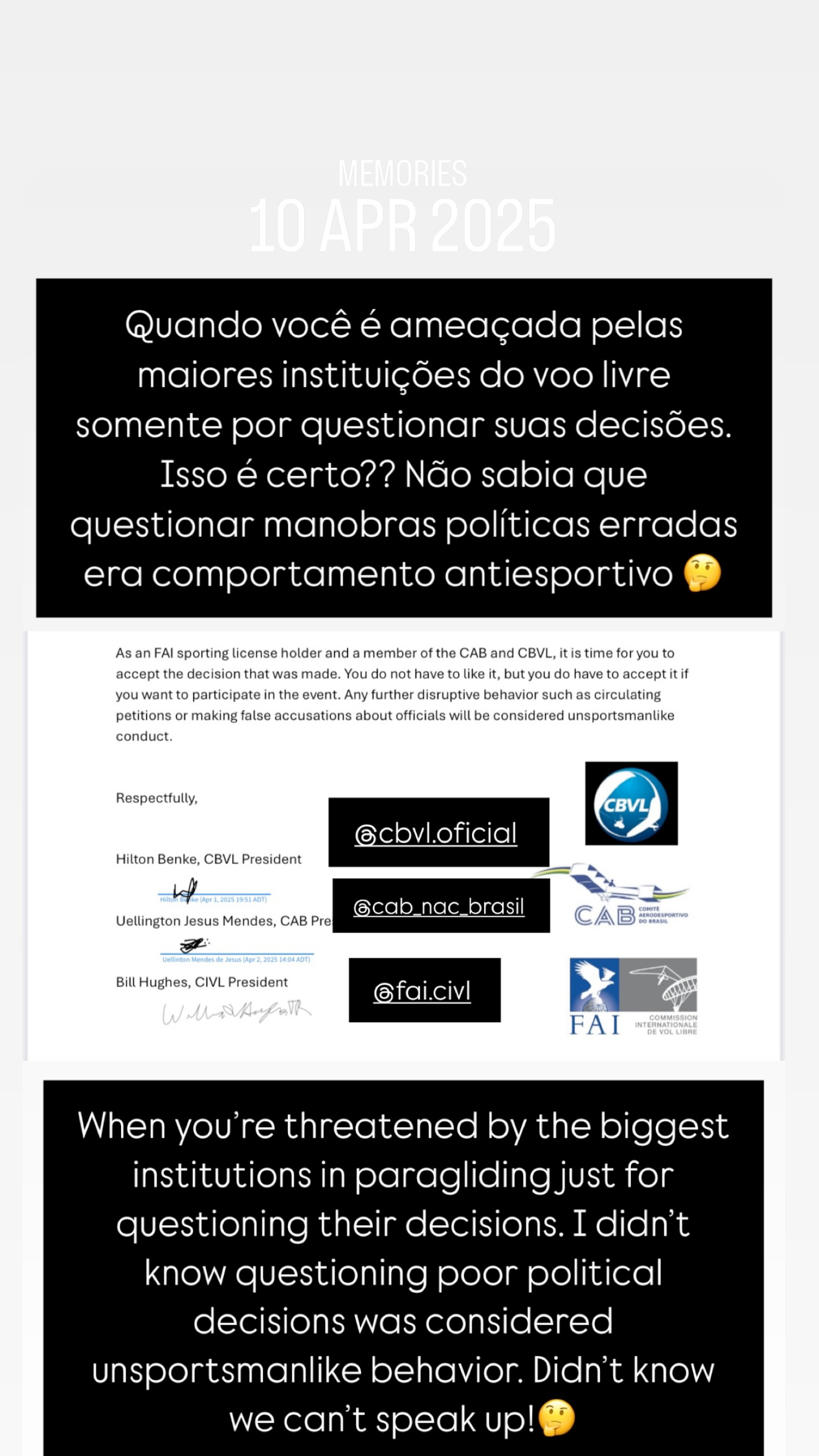
She received the following official answer:
Julien Garcia - FFVL
Julien Garcia started the #CIVLRESIGN movement on Instagram.
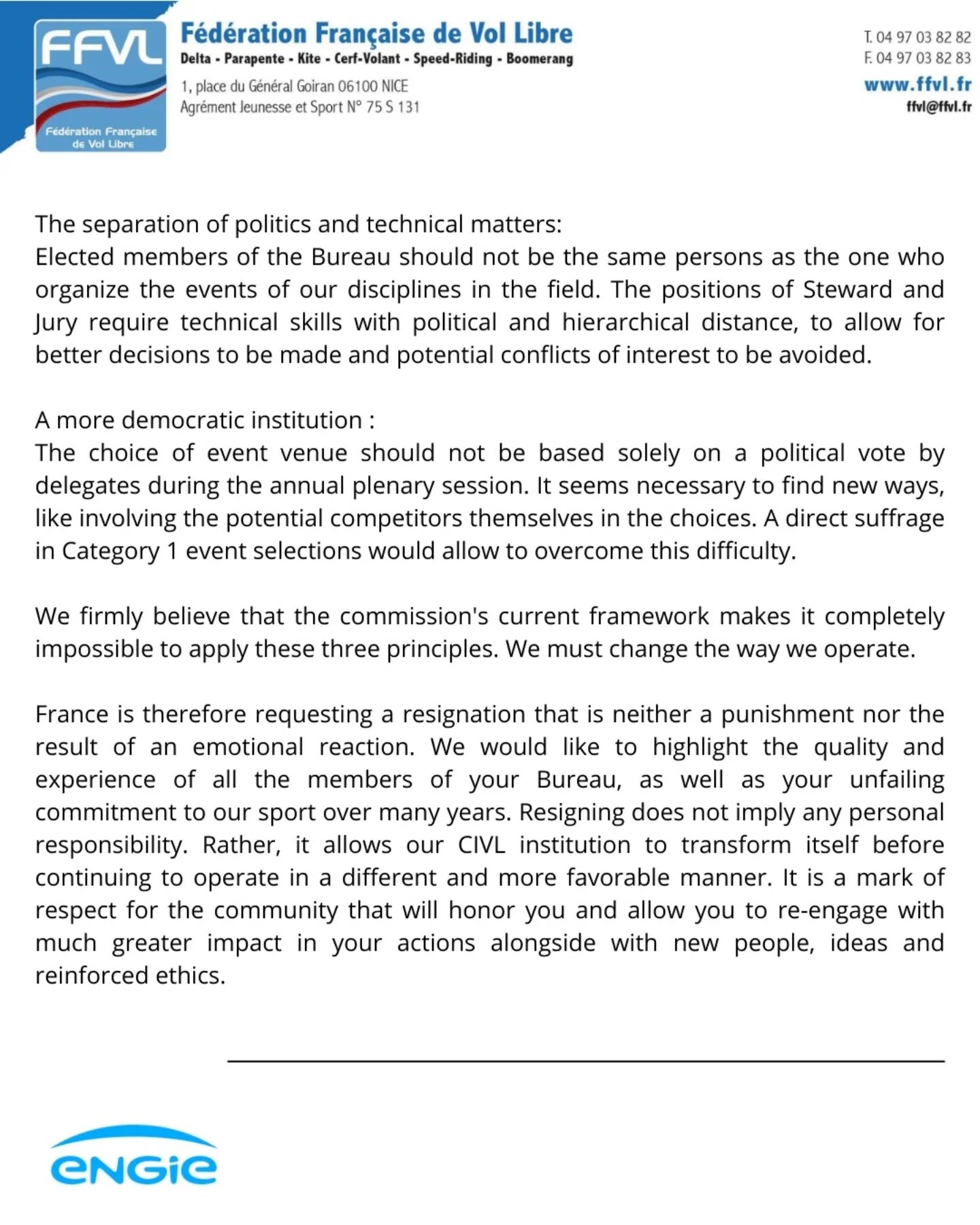
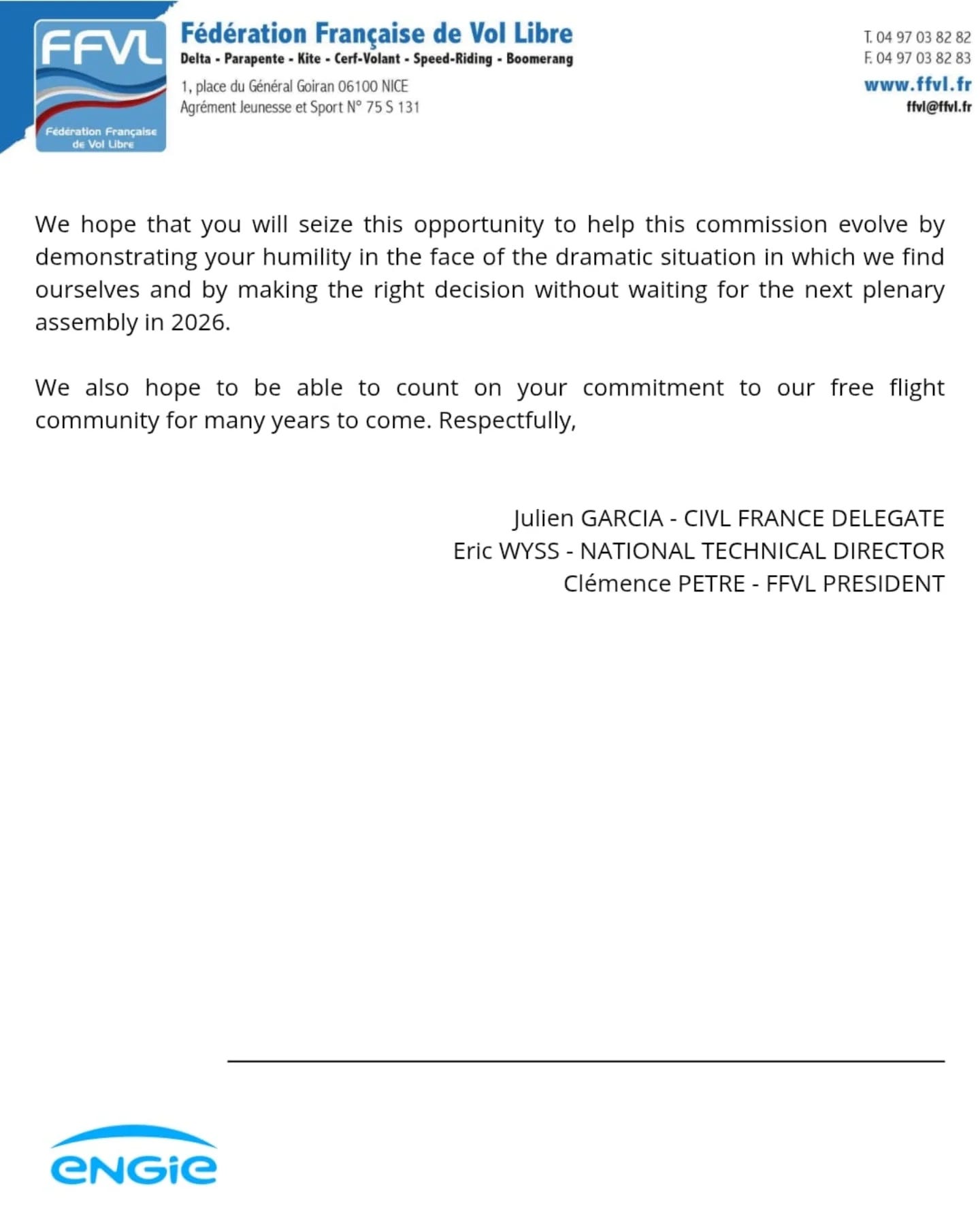
FFVL, the French Federation, officially requested the resignation of the CIVL Board, with the following letter.

My thoughts
Here is the summary of my thoughts:
As you can see by the thousands of likes/comments on Pal’s and Julien’s posts, comp pilots are deeply disillusioned by CIVL today. This is also what I’ve been hearing in person for many years now.
I think we all agree that something needs to change. I don’t believe asking for the resignation of the CIVL Board would solve anything, but I also believe CIVL needs a reform.
We should start building bridges and having dialogues, not destroying teams. The current CIVL Board is one of the most qualified ever to represent PG Cross Country pilots.
The real problem is that the NAC system is broken, and asking for board’s resignation will not fix that.
XC Comp pilots should form a committee that directly represents them, and CIVL should recognize this committee.
Limiting comps to EN-C is the wrong solution. It will just create fake EN-C gliders. Today’s PWC pilots will be flying these fake EN-C gliders with Submarines. It will not make the sport safe, it’ll just destroy the EN-C class.
There should be a safety questionnaire sent after each task. This is the only way to get real feedback on pilot safety.
Technical solutions
Let’s get this EN-C thing out of the way.
The whole Sport class movement has been safe in the last few years, only because it was not about performance / high-level comps.
The first-gen 2-liner EN-C gliders were not designed for top-speed/max-performance.
Pál wrote that “While the evolution of CCC gliders is stuck for years, the EN-C performance became mindblowing”.
Do you know why that is, exactly? Because CCC has been super strictly regulated for years, with the speedbar length + limiter requirement. Manufacturers told me that this limit is blocking the innovation in the CCC class, so much that it is almost impossible to develop better CCC gliders. That is why almost every comp is won by an Enzo 3, which is an 8-year-old design.
And what’s with the EN-C? The C class has almost zero performance regulations, it’s the Wild Wild West! An EN-C wing can have an Aspect Ratio of 7.0, any speed bar length and no limiter whatsoever!
Unfortunately, I’m already seeing how top-speed/max-performance is starting to dominate EN-C with the Gin GTO 3 and BGD Cure 3. Also SRS pilots are moving to Submarines.
I believe in a year or two, we’ll be talking more about how to fix the EN-C class.
Look at the Zeno 2 report. It only has 2 D’s (skip the “Folding lines used” lines, that would give C today). Don’t you realize that Ozone could develop a Zeno 3 with a winglet and push it into the EN-C class?
It’d have an AR of 7.0 and a higher top speed compared to the Enzo 3! Of course, it’d be a “fake” EN-C glider, just like how the Gin Carrera was a “fake” EN-B.
(Today, they have no incentives to develop such a glider, so no worries, it won’t happen. But if World Championship were to happen on EN-C, they’d be forced to make it).
Then we’d arrive at a point where pilots are racing Submarines with Zeno 3s, and GTO 4s and Cure 4s until a few tragic accidents would make us reconsider where it all went wrong.
Unfortunately, we tend to talk about these problems only after serious accidents happen. This is such a dark side of our sport, and I wish it wasn’t like this.
Harnesses and protectors
The safety at our comps has gone really bad recently, even though the design of the CCC gliders didn’t change in the last 8 years. So what did? Harnesses and protectors.
I strongly believe many of the accidents are more serious because of the lack of adequate protectors in the new style harnesses.
It seems we are stuck with Submarine style harnesses, but we need to seriously start adding better protectors to them. If we are settled on 5-6 cm protectors (I hope we are not), then we need to add Airbag systems. Airbag systems have been standard for motor-bikers for many years now. For an illustration, have a look at this bicycle solution which inflates around the neck and head.
We should be integrating these into our harnesses. They’ll finally have the possibility of protecting our hips as well, something which classic protectors never did properly.
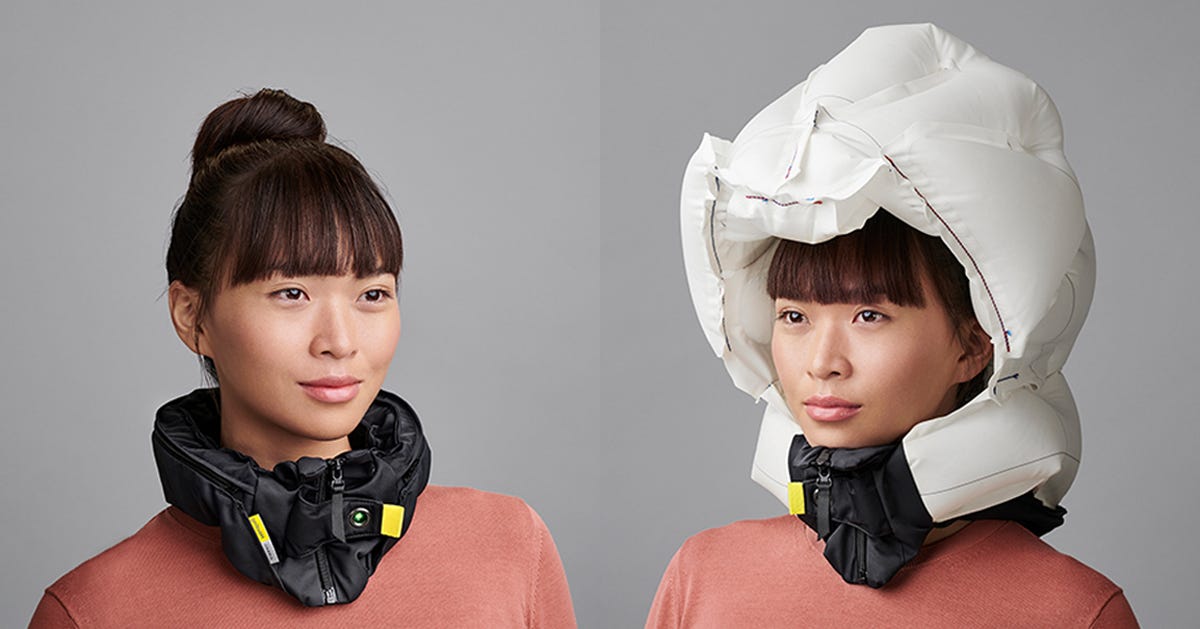
Same with CO2 ejected rescues. Have a look at this video.
Why are these not standard already? These would solve both the slow-opening and the tangling-into-lines problems of our current rescue systems.
From what I know about Bram’s accident so far, I believe a CO2 ejected rescue might have saved his life.
Task design decisions
There are some interesting proposals about the task designs we should talk about. For example to have a min altitude requirement at goal: you’d need to arrive to goal at say 200 meter AGL. If you risk arriving lower, you’ll need to thermal up (time would still stop at ESS). This would solve probably the most dangerous/stupid aspect of our sport, where dozens of pilots are barely arriving a few meters above goal.
Years ago that’s why ESS got introduced, as pilots were racing into the ground. Today, everyone is optimising final glide to ESS and hoping to find a thermal and just barely glide into goal.
Dusan Oroz also proposes some alternative ideas in the PGF thread discussing this, like making it possible to skip turn-points - with a penalty. So say if a turn-point is on a strong lee side, allow pilots to turn back earlier and still make a say, 800 point day, instead of risking their life and pushing into the lee.
Also, FTV is one of those ideas which, on the surface, look like it makes our sport safer, but has the side effect of making everyone risk more / fly closer to the ground. I believe one of the most important safety decisions of SRS was not to use FTV within a comp. (They still have FTV for the full year championship).
Question of responsibility and personal decisions
I believe technical solutions are not the real problem here, but something on the human level. This is a very difficult discussion to have.
If you say that the Meet Director is personally responsible for the safety of every pilot - as much as risking getting into jail if something goes wrong - then no one will organize comps in the future. From what I heard, something like this happened in France this year, and they went from 30+ comps per year to almost none.
On the other side, the other extreme is what we have today, when we keep saying that “you are the best pilots in the world, you make your own decisions, everyone should decide to land when they believe it’s outside of their limits”.
Repeatedly saying this is what made us arrive where we are now. This is just another way of saying if you are a rabbit, don’t come to our comps. Also, it’s very much a macho / manliness measuring contest, no wonder female pilots are underrepresented in our sport.
I don’t think there are black-and-white solutions here; what we need is a dialogue.
We can be angry at CIVL, but PWC comps have an equally bad safety record compared to CIVL Cat 1 events, even though on PWC, pilots directly vote on these issues.
My friend told me that on PWC discussions he repeatedly proposed the idea of having min altitude at goal, only to have it always discarded, because it’d kill the “fun factor” / “adrenaline rush” of our races.
All I’m trying to say that there are no black-and-white sides here. Pilots are not angels. From time to time, after an accident, they are asking for safety, yet they love arriving to goal at 5 meters / pushing full-bar through all kind of conditions / using FTV and sometimes refer to others struggling with conditions as having “skill issues”.
CIVL reform
I believe CIVL needs an internal reform, but it’s not as simple as asking for resignations.
The biggest problem is that the NAC system is broken, and asking for a resignation is not going to change that. By NAC system being broken, what I’m saying that a typical comp pilot has absolutely no idea how his country’s NAC works, who is even the member of their NAC, how do they even contact them and how many bureaucratic steps they need to give feedback / make a proposal. Even the whole concept of how CIVL works through NAC proposals is totally unknown to many comp pilots flying for 10+ years!
So let’s say one pilot successfully contacted their NAC. The NAC would then need to discuss the issue, and hopefully, if the stars are aligned correctly, they’ll write a proposal for next year’s CIVL Bureau meeting.
Then, if, and only if the NAC has the financial means to sponsor their delegate to travel in-person to the other side of the world, the delegate can attend the meeting. On this meeting, the delegate can try to represent the proposal, which was written by a different person months ago. A day or two after the delegate has presented the proposal, there is an in-person voting session (not online!), and if accepted, then CIVL makes an amendment to the Section 7 document for the next year. Any changes afterwards? Start from the beginning and make another proposal the next year.
If the comp pilot is not so lucky to have a good connection to their NAC, the proposal cannot happen. If the NAC doesn’t have the financial means to sponsor their delegate’s travel expenses, they can only view online, without being able to present. In this case, the country’s proposal will very likely fail.
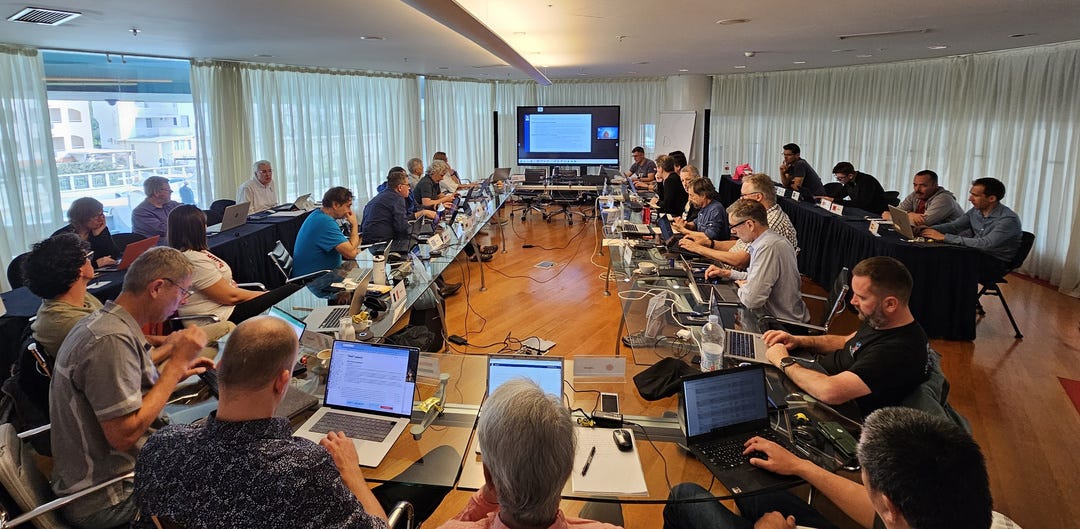
This year for the first time, I represented Hungary as a delegate. As the location was in Europe, I was able to attend the meeting in person. We’ve spent 4 days sitting in a room 12 hours per day and voted on tiny issues like goal line orientation and scoring formula variables.
Then, in the same season, 3 pilots die in 3 month.
I believe something really needs to change. If you read this paragraph out loud to a stranger, they’ll shake their heads and say what a dysfunctional organization.
I understand Julien Garcia’s points. We were sitting next to each other in the same room in the same 4 days.
Things need to change, but I believe we need to build bridges instead of asking for resignations.
What is going to change the system?
OK, here are some very practical proposals:
During a comp, send a daily safety questionnaire after each task to every pilot by email. Currently accidents are only self-reported by the Meet Director, and they tend to “forget” about accidents at their own comps. Also, very important details are not currently collected, like harnesses.
I’m thinking something simple like:Conditions at start were OK / not-OK. Comments
Conditions at goal were OK / not-OK. Comments
Comments about task
Comments about meet director
Mid-air collisions you saw during the task
Accidents / rescues you saw during the task
Luckily AIs today are extremely good at summarising 130 responses into a short text, so it won’t be a burden for anyone to read these.
Make a committee directly representing cross-country competition pilots. Let’s call it Cross-Country Pilots Committee or CCPC. CIVL should recognise this committee and accept proposals from them just like they accept proposals from NACs. Cross-Country Pilots Committee could even have voting rights, if somehow we can make it possible within FAI.
CIVL needs to do something with this “spending 4 days in a room to vote on scoring formulas and goal line orientations” while people are dying on our comps!
I believe we should move smaller issues to quarterly online votings and dedicate the annual in-person meeting to issues like safety.
About FAI and CIVL
I think many of my readers probably don’t know what’s our relationship to CIVL and FAI and who are even our CIVL board members. I don’t blame you, CIVL is really bad at communicating what they do. The only time most pilots see these names is when they have to pay for FAI license or register for a comp on civlcomps.org.
OK, so FAI is The World Air Sports Federation. It was founded in 1905, so we are talking about a 120 year old federation.
CIVL is the Hang Gliding and Paragliding Commission of FAI.
Most importantly, it is not a direct democracy, but a representative democracy. The members of the FAI are not people, but national organizations. For each country, there is one recognized National Airsport Control (NAC). Examples include the BHPA in the UK, or the DHV in Germany. NACs have their own selection processes in each country, which might or might not be democratic.
Representation: Each member country gets one vote. This all comes to a head once a year at the CIVL Plenary Meeting. This is where all the delegates from every member nation gather to vote.
So this is what’s given, it’s a super rigid structure by a 120 year old organization. I believe pilots behind #CIVLRESIGN don’t understand how rigid this structure is, and that our only way to make it better is to work within this structure and try to fix it.
I tried to give 3 proposals above which can hopefully work in the existing system.
Daily security questionnaires: we can definitely do this today. I’m happy to volunteer on the software side of this.
Allowing a Cross-Country Pilots Committee to represent at meetings: this should be possible. Giving voting rights to them might not be, but we should try.
Quarterly online votings is something we should really really push for. If we need permission from FAI then we should do everything to get that permission.
Finally here is a photo of the CIVL Board at the time of the last plenary meeting in 2025.
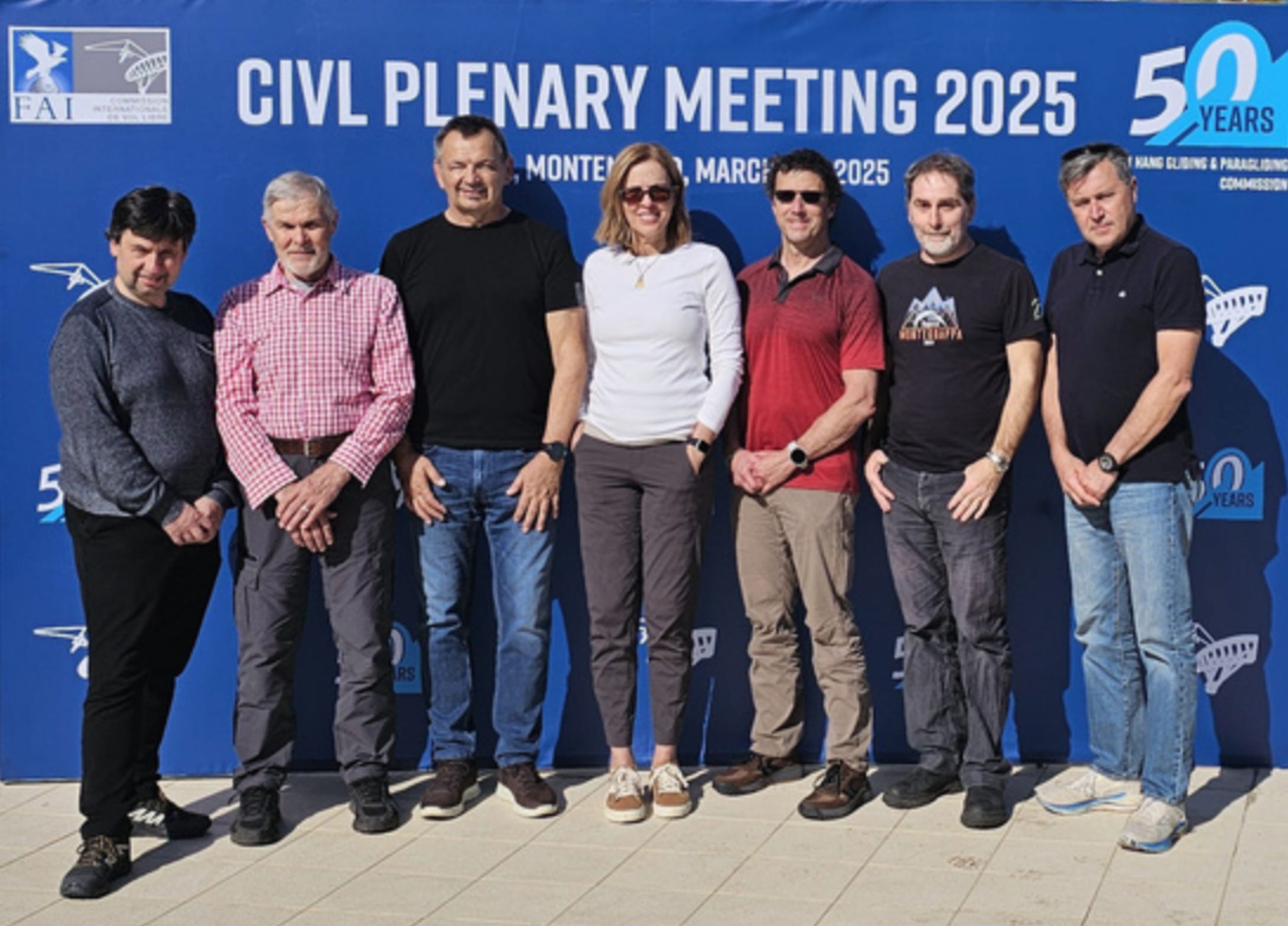
As I said I’ve only been a delegate for one year, but people who have spent some time in CIVL say that this is actually one of the best boards we ever head for representing XC comp pilots. Bill, Goran, Zeljko and Fabio are still active XC competitors and/or meet directors today.
Potential for change
Finally, I wanted to share a story about the potential for change, especially involving the French team.
I vividly remember the 2023 World Championships in France. It was the competition with the worst safety statistics of anything I’ve ever been to or even heard of. In total, I believe 21 pilots had accidents, about 18 of them threw rescues, of which maybe only 6 opened.
The strong valley winds between the 1800 meter ridges were way over the limit for many pilots unfamiliar with the area but were OK for the French team, who knew this place inside-out.
Many of us will never forget, how every time we discussed the safety aspect during the comp, the French pilots reacted calling it a “skill issue”. Every time the tasks were “only” 90-100 KM closed triangles, they were upset that we were not flying 150 or 200 km tasks on such perfect days.
Then Timo’s tragic accident happened during the 2024 French Open and I believe it changed everything in France. The same pilots who were the loudest back then are now standing up for improving safety on our sport - and I’m glad they do.
I’m saying this as an example that change is possible.
We need to start a discussion and find a way to fix things which are broken, not just ask for resignations.
Great piece. I believe it reflects the views of a very large group of pilots. It’s worth adding the incident from the British Winter Open 2025, when Franz bled out while waiting for help. Where are the findings from that accident, not to mention the consequences?
Thank you, Zolt, for your great commitment to the safety of competition pilots.
You have made some excellent suggestions, such as setting minimum heights for goals and providing safety protectors for harnesses. We could compare ourselves to the world of Formula 1, where there were many fatalities among pilots in earlier years. Now, every F1 car has a safety cage, and since then, the drivers have been relatively safe. Our 'cage' would need to be built around our harnesses. That's why I fly an Advance Impress 4 — it has excellent protection all around, and it's slow but safe. I've heard that the Kortel is comparable to that. Perhaps the industry could work on optimising the aerodynamics of these harnesses?
I had two serious collapses with my Zeno 2 this season – I was lucky to manage to reopen the twisted glider both times. Another pilot had to land just beside me using his parachute (he was flying an Enzo 3). Thankfully, no injuries occurred. But there was a lot of luck involved...
That's why I don't want to switch to the Submarine with an Enzo 3, even though I know I could fly much faster with that setup. But why would I want to? I'd rather stay alive and healthy, I do not earn money from competition flying anyhow (who does anyway?).
So let's all think about how to make competitions safer without losing the fun for pilots and MDs.